Anna Rai is a specialist in the world of classic cars and the founder of Race Elegance in Switzerland. She brings together design, aesthetics, and automotive heritage in her work, collaborating with collectors and taking part in prestigious events. In this interview for AutoClassicNews, she talks about the beginning of her professional journey, her passion for classic cars, and why their popularity continues to grow year after year
-How did your passion for classic cars begin?
-I have only one memory of my father from childhood. I was four years old. He lifted me onto his shoulders, we were standing in the kitchen, and we sang a song together. A song about getting into a convertible and driving somewhere far away. That is all I have of him.
The next 28 years were silence. No phone calls, no letters, no birthday gifts, no Christmas. No child support. Nothing. He simply wasn’t there.
In 2022, six hours before New Year’s Eve, my mother asked if I would be open to speaking with him. I said yes. Everything inside me turned upside down. I told him directly: don’t expect too much from me, you weren’t part of my life. But I hold no grudge. Let’s forget the past and look forward. And I added, with a smile: I’ve already driven somewhere far, just like in that song. I don’t have the convertible yet, but we’ll fix that, and then we’ll do a tour of Europe together. But our trip never happened.
In 2023, I understood something: life is too short to hesitate. And that change is nothing to fear. The more I worked with cars, the more I felt my father’s presence beside me.
-You have worked in engine restoration and you are passionate about classic cars. Could you tell us more about this experience?
-I want to clarify something here. Classic car restoration is my passion, my hobby, the world I live in. But professionally, I worked at ZSW Zelinderschleifwerk AG, a company specialising in engine restoration for cars, boats, and tractors. I worked there as a mechanic’s assistant. These are two different things, and that distinction matters to me.
We were a team of nine, seven of us working in the workshop. Every other day, a fully restored engine left our hands. The pace was demanding, but that rhythm taught me discipline and precision in a way nothing else could.
I deeply value the experience and knowledge of my colleagues, Stefan, Hanspeter, Fritz, and Michael. Each of them taught me something I could not have learned from a book. And I want to express my sincere gratitude to my director Marcel and his wife Natacha, extraordinary leaders and truly wonderful people.
Among my favourite projects was a 1935 Rolls-Royce 20/25 HP, chassis number GSF 22. There is something extraordinary about holding a piece of engineering from that era, understanding how it was built, and bringing it back to life. Every component tells a story of craftsmanship that simply no longer exists in the same way today.
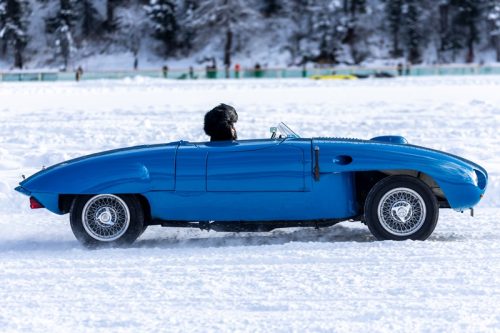
Another project I hold very close to my heart was the restoration of the compressor and carburetor for the Peugeot 203 Barbier from OldieBox, a one-of-a-kind automobile. I had the honour of presenting it before the jury at The ICE St. Moritz and driving this magnificent, completely unique car across the ice. That experience was unforgettable.
Today I run my own company, Race Elegance, based in Switzerland. We focus on private collection management, graphic design, and creating products built around the world of classic automobiles, from visual identity to curated experiences.
—You are involved in organizing Concours d’Élégance Suisse and Anantara Concorso Roma. Could you tell us more about your role and responsibilities?
-These two events represent very different chapters in my journey, and I treasure both of them.
Concours d’Élégance Suisse was actually one of my very first roles in the world of historic automobiles. I worked there as a social media manager, learning the language of these events, understanding their rhythm, their audience, their soul. It is a beautiful event. Warm, family-spirited, intimate in the best possible sense. I am endlessly grateful for that experience, and I still maintain a genuine friendship with my former director to this day.
Anantara Concorso Roma is a different kind of relationship, one that has grown into something I hold very close to my heart. This is now my third year as Ambassador and the face of the event. My role goes beyond attendance. I represent Anantara at other events throughout the year, and I also assist the team in sourcing rare and significant automobiles for participation. This is very much a collective effort, other team members are equally involved, but I contribute where I can, which requires deep knowledge of collectors, provenance, and what makes a car truly worthy of such a stage.
The first year was an intense one for the entire team. We all worked incredibly hard. Then in 2025, the event was cancelled following the passing of Pope Francis. It was a deeply respectful decision, and what moved me profoundly was that despite the enormous effort the entire team had invested, William and his family chose to honour that moment of mourning. That decision said everything about who they are.
That shared experience brought the team closer together. And in 2026, the event returned, and it was nothing short of extraordinary. The organisation was impeccable, the atmosphere unforgettable. I am endlessly grateful to this team. They are truly remarkable.
I am delighted to share that Anantara Concorso Roma will open its doors again from the 1st to the 4th of April 2027 in Rome. I hope to see you there.
I want to express my sincere gratitude to William Heinecke for entrusting me with this mission. That trust means everything.
-Is your work different within these two teams? If so, what are the main differences?
-Very much so. At Concours d’Élégance Suisse my role was focused on social media, capturing the event and communicating it to the outside world. It was about storytelling through content.
At Anantara Concorso Roma my involvement is much broader. I am an Ambassador, which means I represent the event year-round, not just during the days it takes place. I work on sourcing cars, building relationships with collectors, and presenting the event at other occasions across Europe. It is less about documenting and more about shaping.
One is a lens. The other is a seat at the table.
-Who is more challenging to work with: collectors or event organizers?
-Honestly, collectors. Event organizers work with deadlines, structures, and clear objectives. You always know where you stand.
Collectors are a different world entirely. Each one has their own philosophy, their own emotional relationship with their cars, their own idea of what is worthy of attention. Gaining their trust takes time. And their cars are not just assets, they are extensions of their identity. You have to approach that with great care and genuine respect.
-In the biography on your website, you mention that you enjoy telling the stories behind automobiles. What does that mean to you? Are you referring to the history of the brand, the car itself, or its owner?
-All of it, but not separately. For me, a car is never just a machine. It is a living archive.
Every automobile carries layers of history. The vision of the engineers and designers who created it. The era it was born into. The hands it passed through. The roads it travelled. The people who loved it, restored it, sometimes forgot it and found it again.
When I tell the story of a car, I follow its entire existence. From the factory floor to where it stands today. Because somewhere along that journey, the car stopped being an object and became a witness. To lives, to decisions, to moments in history that shaped the world around it.
A perfect example is the 1926 Rolls-Royce New Phantom I from the OldieBox Collection, which I had the privilege of presenting at Concorso d’Eleganza Villa d’Este. One hundred years of history held in my hands. What made this experience truly special was the time I had to get close to this car beforehand, polishing the silver and working on parts of the engine. Those quiet hours beside it were where the real connection was born.
That is what draws me in. Not the horsepower. The humanity behind it.
-In a world where a news story or photograph remains relevant for less than a day, do you think a race or rally can still exist outside social media?
-Not only can it exist, I believe the most meaningful moments happen precisely outside of it.
Social media captures the surface. The image, the caption, the fleeting second of attention. But standing beside a 1930s racing car as its engine comes to life, feeling the vibration in your chest, smelling the oil and fuel, hearing a sound that no speaker can reproduce, that cannot be scrolled past. It lives in you differently.
Classic car events have survived decades without algorithms. Their power was always in presence. In the community that gathers around these machines and understands, without words, what they represent.
And I don’t just talk about this, I live it. This year, on my birthday, the 12th of June, I drove the Nordschleife together with my colleague Thomas in a 1934 Wolseley. No filter, no caption could ever replace what we felt on that track. That experience belongs to us alone. Social media is a door, a wonderful door, and I use it every day. But what is behind that door, the event itself, the cars, the people, the atmosphere, that exists on its own terms. And it always will.
-Despite digitalization, Europe still has many print publications. In your opinion, what type of content works best on social media, and what is better suited to print media?
-Social media is about the moment. Emotion, movement, immediacy. A short video of an engine starting, a single striking image, a story that disappears in 24 hours. These work because they demand nothing from the viewer except a second of attention.
Print is about permanence. A beautifully photographed spread of a 1960s Ferrari in a magazine is something you return to. You hold it, you study it, you keep it. Print gives a car the dignity it deserves, space, silence, and depth.
In my world, social media opens the door. Print is the room you remember.
-According to the Financial Times, the average age of a classic car owner in Europe is 60. Do you think social media can change the perception of the «exclusivity» of this community and attract a younger generation? If so, how?
-Absolutely. And it is already happening.
Classic cars were once a closed world. You needed connections, knowledge, and significant means to even enter the conversation. Social media has changed that. A 25-year-old in Gothenburg or Berlin can now follow a Concours d’Élégance in real time, learn the history of a Bugatti Type 35, and feel part of something they would never have discovered otherwise.
But exclusivity doesn’t have to disappear. It simply needs to be reframed. Not as a barrier, but as an invitation. The younger generation is drawn to authenticity, craftsmanship, and stories that stand against the disposable culture around them. Classic cars offer exactly that.
My job, in part, is to be that bridge.
-You attend a large number of events. Based on your observations, who makes up their primary audience?
-Honestly? The cars.
I know that sounds simple, but it is the truth. When I arrive at an event, my eyes go straight to the machines. The people around them, the collectors, the judges, the visitors, they are part of the atmosphere. But the car standing alone on the lawn, in the morning light, before the crowds arrive, that is the moment I am there for.
-Why do you think interest in classic cars continues to grow despite rapid technological development?
-Because technology moves forward, but people look back.
We live in a world of screens, algorithms, and instant everything. Nothing lasts, nothing has weight. And then you stand in front of a car, like the 1937 BMW 328 «Bügelfalte», which this year was crowned Best of Show at Villa d’Este, and suddenly you feel something the modern world rarely offers: permanence. Intention. The sense that someone put their hands, their mind, and their soul into creating this object. From the Mille Miglia circuit in 1937 to the lawns of Villa d’Este, it still knows how to steal the spotlight.
Classic cars are the opposite of disposable. They were built to endure. And in a world that changes faster than we can absorb, that is not just appealing, it is necessary.
They are also deeply human. Every curve, every detail was a decision made by a person, not an algorithm. You can feel that. And people are hungry for that feeling.
-You hold several diplomas in design. Has this educational background been helpful in your current work?
-I have four completed educations, three of which are higher degrees. So yes, though perhaps not in the way people might expect.
But honestly, it goes far beyond diplomas. Design has always been my way of life, my language of expression. It is the language of culture. And that is very close to the world of automobiles.
-By the age of 19 I was already making my mark in the fashion world, and at 21 I had my own business. Working with aesthetics, form, colour, history, and materials. Building relationships with people. Dozens of shows, publications in various magazines and media. And in 2022, a nomination for the Best Designer of the Year award from the city of Munich.
That background shapes everything I do today. Design teaches you to see. To analyze, to question, to find solutions where others see only problems. That critical thinking is something I apply every single day, whether I am curating a collection, building a visual identity for a client, or navigating the complex world of historic automobile events.
-It is not about drawing skills or knowing color theory. It is about the discipline of looking at a challenge from every angle before you act. That, more than anything, is what my education and my life in design gave me.
-As a fashion designer, would you be interested in creating a collection inspired by motorsport or racing culture?
-Absolutely, and it is something I genuinely see for myself in the future.
Right now I am fully immersed in the world of events, collectors, and historic automobiles. The pace is intense and I love it. But there will come a moment when I want to slow down slightly and channel everything I have absorbed, the aesthetics, the history, the sensibility, into something more tangible.
A collection inspired by racing culture would be a natural extension of everything I live and breathe. Not a costume, not a theme. A genuine dialogue between the elegance of a bygone era and the way we dress today.
That conversation is waiting for me. I am not in a rush.
-You spent many years practicing freestyle wrestling. What qualities did sport instill in you?
-Ten years of professional sport. And I owe everything to my coach, Alexander Tkachuk. He became a father figure to me, the one my own father never was. He kept me off the streets at a time when many of my friends and classmates lost their way very quickly. Drugs, alcohol. Lives that ended too soon.
I grew up as a girl from a village. We lived in a single room of ten square metres in a dormitory. One kitchen, one bathroom shared between five families. My mother I barely saw. She worked constantly, just to keep us alive. At school they called me a homeless girl because I wore second-hand clothes.
Sport was my only ticket out. My only way to survive. And I used it.
Wrestling taught me discipline, resilience, and the ability to get back up every single time. It taught me that your circumstances do not define your ceiling. That the only person who decides how far you go is you.
Everything I have built since then stands on that foundation.
-Does your athletic background help you achieve your professional goals?
-Without question.
Professional sport teaches you things no university can. How to perform under pressure. How to face an opponent, or a challenge, and not flinch. How to lose, recover, and come back stronger. How to push past the point where most people stop.
When I walk into a room full of collectors, CEOs, and people who have spent decades in this world, I am not intimidated. I have stood on a wrestling mat in front of a crowd and competed for everything. That experience lives in your body. It changes how you carry yourself.
It also taught me patience. In sport you do not win on the first day. You train, you fail, you adjust, you try again. Building Race Elegance has been exactly the same. There are no shortcuts. There is only the work.
My coach gave me the discipline. Sport gave me the belief. Everything else followed.
-Are there any collectors or companies you would like to collaborate with in the future?
-This is something I think about carefully. The classic car world is full of extraordinary people and institutions, and I am selective about where I invest my energy and name.
What I know is that any future collaboration must share the same values I have built Race Elegance on, authenticity, depth, and a genuine respect for the history behind these machines. Whether that is a private collector with a remarkable story to tell, or an institution that understands what it means to be a guardian of automotive heritage, that alignment is everything to me.
The right collaborations will come. I am patient.
-What kind of project would you refuse to take on?
-Electric cars! I know that might sound provocative in today’s world, but I have to be honest. I simply do not feel them. There is no soul, no sound, no conversation happening between the driver and the machine. You press a pedal and you move. That is not what drew me to automobiles.
My work has always been about emotion, about history, about the living connection between a human being and a mechanical object that was built with intention and passion. Electric cars, for me, do not carry that. Not yet. Perhaps not ever.
I respect the technology. But I cannot tell a story I do not feel.
-What does success mean to you?
-Success, for me, is understanding that we are only guests on this planet.
The pursuit of fame, of recognition, of status loses its meaning the moment you truly internalize how brief our time here is.
Although, if you ask the cars, they might disagree. For them, success is a different matter entirely. A debut at The ICE St. Moritz. A class win at Villa d’Este. A trophy at Pebble Beach. A ribbon at Chantilly. A standing ovation at Goodwood, Cavallino, Amelia Island, Hampton Court, The Quail. Perhaps that is success too. And who am I to argue with a 1928 Alfa Romeo?
For me, though, real success is waking up and doing work that feels honest. Being present for the people who matter. Leaving something behind that has meaning, not a number of followers, not a trophy, but a feeling. A story told well. A car preserved for the next generation. A moment someone remembers.
That, to me, is enough. That, to me, is everything.